

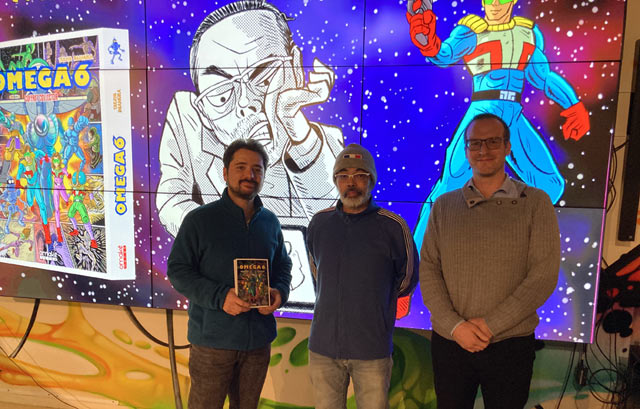
Florent Gorges, Takaya Imamura and sseb22
At the end of November, we learned of the arrival in 2023 of a neo-retro visual novel based on the recent manga Omega 6 by Takaya Imamura, but we did not immediately relay the information because we knew that we were going to learn more during a conference organized by Omaké Books. But above all, as usual when he meets the big names in Japanese video games such as Yoshihisa Kishimoto, Hironobu Sakaguchi, Satoru Okada or even Tomohiro Nishikado, our friend Florent Gorges immediately suggested that we ask the former artistic director of Nintendo if he would agree to be inducted as an honorary member of the association. Florent also invited us to one of the conferences he organized in France with Mr. Imamura and our shock reporter sseb22 therefore went there and offers you the report below, which looks in detail at his career which we have summarized for the press release.
Guillaume Verdin, editor-in-chief
Conference by Mr. Imamura, former artistic director at Nintendo, for the release of his first manga OMEGA 6 at Omake Books
As part of his small French tour (Paris and Toulouse) organized by Omaké Books, his publisher, Takaya Imamura gave a conference at the Espot on December 2, in the center of Paris, allowing him to look back on his thirty-year career at Nintendo and present his first manga, Omega 6.
His childhood and his inspirations
Takaya Imamura was born in Nara Prefecture, Japan. He has been drawing since childhood, including a four-panel manga published in the school newspaper. During this period, he wanted to become a mangaka, especially because his father was a mangaka and already drew “4 boxes”.
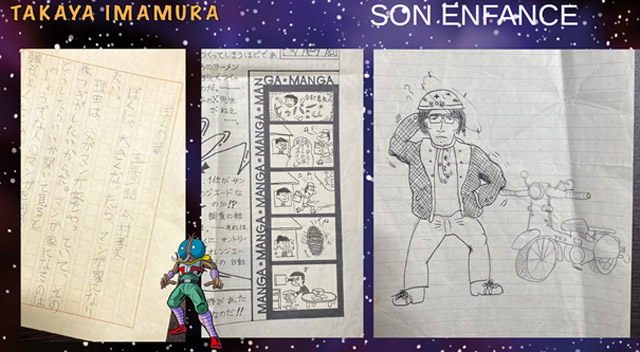
On the left, the manga in four panels and on the right, a caricature of his main teacher at college
Among his influences, he immediately cites Star Wars which changed his life and from which he experienced the madness which had taken over Japan. He was a fan of it for years. This is how he reproduced around the age of fourteen the images that were in an album of film music. He was then crazy about Hollywood cinema (E.T., Gremlins, Steven Spielberg) and science fiction (hence the obvious influences in Omega 6).
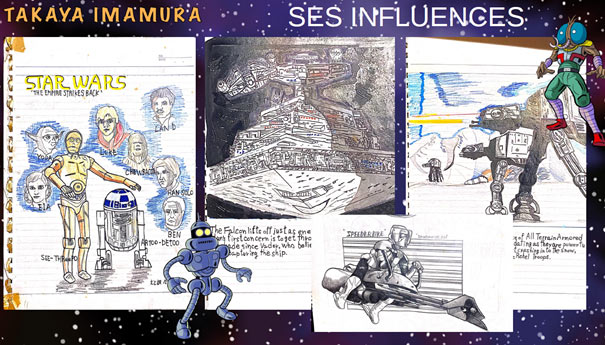
Drawings in the Star Wars universe of which he was a fan
Before joining Nintendo, he studied arts at Osaka International University. At the time, of course, there were no computers, only drawing by hand. In his third year of university, he learned that a friend had been hired at Konami. A fan of video games (he owned Game and Watch and played on Famicom), he experienced the boom caused by Super Mario Bros. at university. in 1985. Mr. Imamura therefore knew about video games but during his studies, he had not made the link between drawing and video games. In fact, he thought that it was purely computer science and that only programmers could work in this environment. At that time, he had never seen a computer keyboard. No one around him had one. He thought he would become a chara designer in the toy industry (particularly to create robots).
But the recruitment of his friend opened his eyes and he then sent letters of application to Nintendo and Konami. Job tests and exams at Konami took place in a brand new building while Nintendo, a company which had just celebrated its hundredth anniversary, had old and dilapidated premises despite their leading position. Hiring is done in several stages and he chose Nintendo because they responded first and his mother pushed him to join Nintendo.
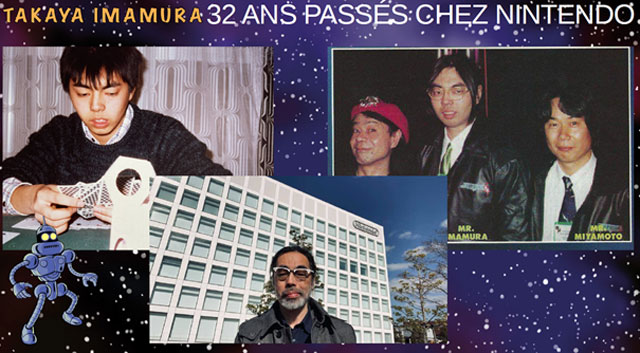
Several photos of Mr. Imamura at different times at Nintendo
During one of the interviews, Shigeru Miyamoto asks him what his favorite game is. For fear of coming across as a bootlicker, he answers Metroid. For his favorite films, he answers Indiana Jones (because it is a successful film that appeals to all audiences) and Brazil (because it represents the will and the way in which an artist can impose his vision). As a presentation portfolio, he brought academic and personal drawings, including plates from a manga prototype already very similar to Omega 6.
The Super Nintendo period
He joined Nintendo in 1989 and participated directly in the F-Zero project. It’s a huge surprise and an honor for him to learn that he will work on the brand’s next home console. He therefore begins his collaboration with a mixture of excitement and fear of not being up to the task.
As preparation, he takes training to draw in pixel art. He thus discovers mode 7, a great sensation! Thanks to this training, he learned how to create settings and characters with the technical constraints of the consoles of the time: sprites around thirty pixels high and only in sixteen colors. Fortunately, at the time, graphic designers knew how to use the characteristics of CRT screens to bring nuance to the colors.
When he starts on F-Zero, there are no characters. The driver is not seen in the vehicle. Despite this, he finds it a shame. He therefore drew several to develop the F-Zero universe and the team agreed to integrate them. Without that, there probably would have been no characters and nothing but vehicles on the box. And this allowed the game to stand out from other racing games, a genre in which at the time there were rarely characters, and to also develop the game universe a little. In the manual, many players remember the presence of a comic strip. It was indeed Mr. Imamura who drew it but it was the Americans who finalized and colored it.
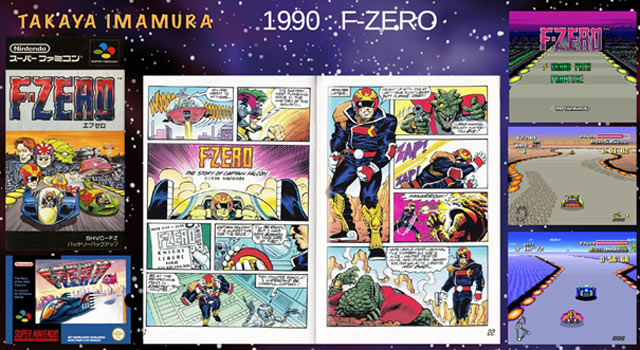
The comic included in the F-Zero instructions
The next important project he worked on was Star Fox (1993). In between, he helped make the bosses in A Link to the Past (1991) scarier and designed half of them as a result.
On Star Fox, as with F-Zero, Mr. Imamura insisted that there be 2D character portraits appearing on screen in order to somewhat compensate for the very “low poly” 3D – even by the standards of the time. Additionally, he finds there is an interesting contrast between the animals with 2D portraits and the 3D game. It is indeed Nintendo's strength to marry heterogeneous elements and innovate by combining them even though they would be considered classic or even banal if taken alone (in the spirit of Gunpei Yokoi's famous maxim: "The lateral thinking of obsolete technologies").
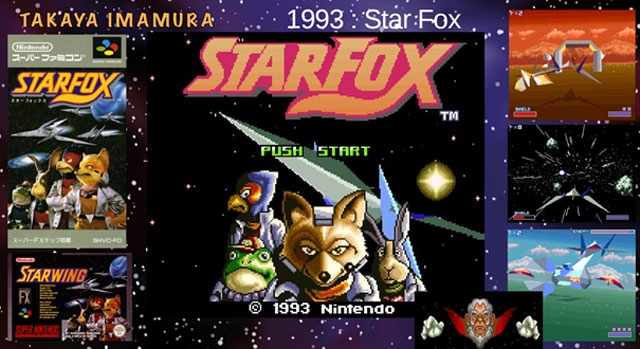
Illustrations from Star Fox including puppets, used for the cover in order to make an investment profitable for an advertisement intended to be national and which was only broadcast locally
The Nintendo 64 period
In 1996, Nintendo officially entered the 3D era and everyone was trained in the creation and development of 3D games. Having worked on Star Fox (1993), Mr. Imamura wanted to settle for a simple Arwing with few polygons and was ultimately very impressed by the possibility of doing texture mapping that was so realistic for the time. Development of Star Fox 64 (1997) began in 1995, just after the cancellation of Star Fox 2 on Super Nintendo (for which he, among other things, created the artwork for the SNES Mini). Star Fox 64 is the game Mr. Imamura spent the most time on: he created 70% of the graphics and suggested the voice system. It was the most important play of his career.
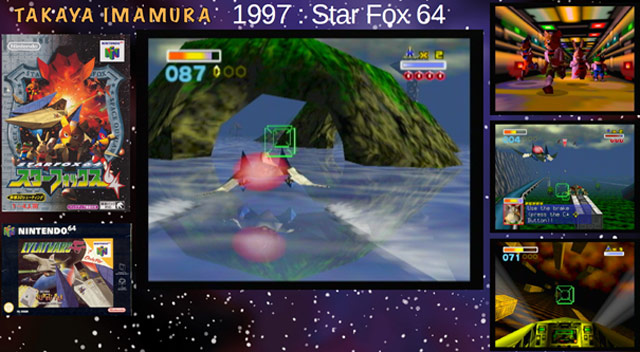
We can clearly hear in this image the characteristic sound of the voices of the characters from Star Fox 64 (or not)
Speaking of voices, he remembers insisting that the game talk a lot. Indeed, the PlayStation was then released and crushed the competition. However, a large number of games are fully dubbed on this console thanks to the CD and he wanted to prove that Nintendo too could do something equivalent. Unfortunately, between a 650MB CD and an 8MB (64Mb) cartridge, there was a memory space problem. They did some tests with Imamura's voice but it had to be compressed a lot, so much so that it sounded like radio, which ended up going well with the radio transmissions between the characters during the game.
After Star Fox 64 (1997), Mr. Imamura worked on F-Zero X (1998) for which he created many characters. Starting from a technical challenge, the Nintendo 64 allows thirty vehicles to be displayed. The goal was to display as many images as possible while remaining at sixty frames per second. So, even if it meant having thirty vehicles, Mr. Imamura decided to make thirty different ones with thirty drivers.
At the beginning, he was "director" of the game but the workload with these thirty characters to create then became too important because he also did the user interface, the design of the circuits... so a second director arrived, Tadashi Sugiyama.
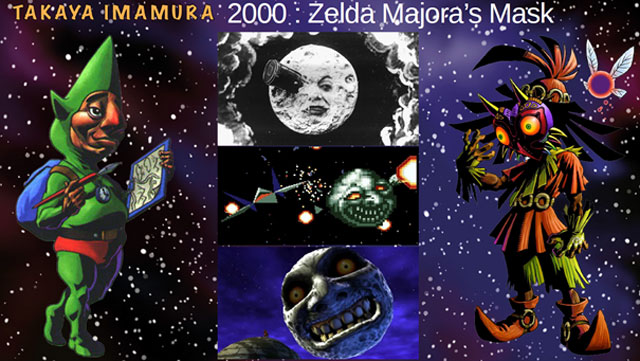
Mr. Imamura, in the moons (from top to bottom: that of Méliès, that of Star Fox then that of Majora’s Mask)
And let's not forget that he created a remarkable character in the person of Tingle. Its design was based on functional needs for gameplay: it is a card seller that must be easily located. That's why he flies him with balloons to get him high and pops them. But since it’s weird to do that, he made him a weird character. In fact, his full tights come from the fact that Japanese comedians sometimes dress like that, to be intentionally ridiculous.
Takaya Imamura has also worked on a plethora of Nintendo games and has created over one hundred and fifty characters for all of these games. Main and secondary characters, bosses, mechas... came out of his fertile imagination for productions, in addition to the F-Zero and Star Fox sagas, as diverse as Steel Diver (2011) and Tank Troopers (2016)...
But as we mentioned at the start of the article, Mr. Imamura wanted to become a manga artist when he was young. And this is how, more than thirty years later, he can realize his dream: finish and publish a manga.
His manga Omega 6
He announced his departure from Nintendo to Florent Gorges, whom he had already known for several years, and told him of his plans to become a university teacher – he currently works at the International Professional Technological University of Osaka – and to do freelance illustrations. In this conversation, Mr. Imamura also told him, half-jokingly, that he was going to draw a manga. Florent then pushes him to go all the way and promises to publish his manga, at least in France.
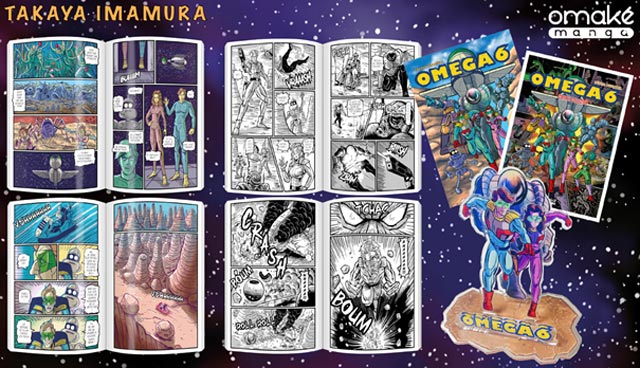
The Omega 6 manga in its black and white version and also colors for the collector's edition
Omega 6 is a science fiction manga, a hyper-referenced summary of what Imamura-san likes. At first, he wanted to make a short version in black and white but his publisher convinced him to make a full color version for the collector's edition, allowing him to enjoy even more of its SF atmosphere with a look paying homage to the 1970s, whether with the colors of the backgrounds or the "spiky" frames.
And an additional announcement at the end of the conference, there will even be a video game which will be released in 2023 adapting the manga on Switch. It's a text adventure game by Happymeal, who has created more than fifty games on Android, and planned for 2023 on Switch with a retro futuristic atmosphere. Mr. Imamura will create all of the graphics for the game and promises that it will be a new story compared to the manga.
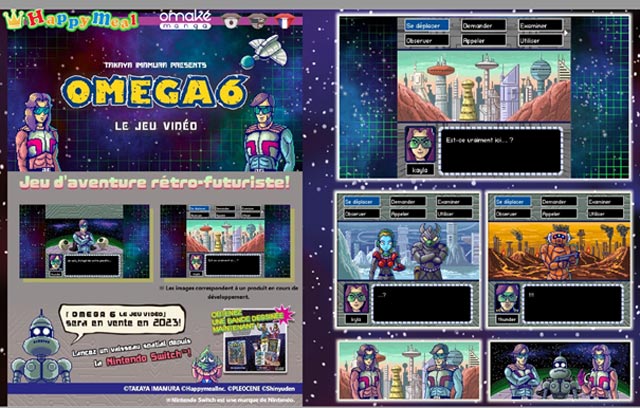
Omega 6, the video game, a text adventure game planned for Switch in 2023