
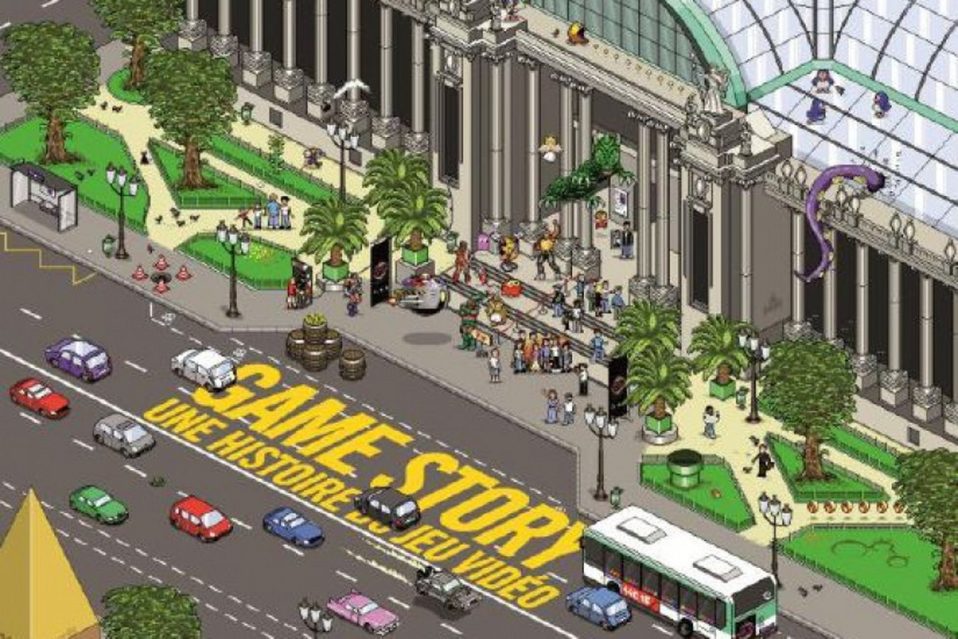
Game Story is an exhibition organised by the Rmn - Grand Palais with the collaboration of Musée national des Arts asiatiques Guimet and the association MO5.COM
This exhibition marks the reopening of the Galerie sud-est, a new exhibition space in the Grand Palais.
Video games emerged in the early 1970s as a young medium that has continued to evolve and develop to become a major cultural industry.
Ever since it first appeared on the scene, this new medium has been the subject of much discussion and analysis, focusing primarily on the social and personal impact of its use. The aim of this exhibition is to take a different, aesthetic and cultural approach.
A technical and aesthetic history
The history of video games is closely linked to the technical developments that have enabled creators to offer increasingly rich and diverse game worlds and experiences. Thanks to ever more powerful computer components, each new generation of video game hardware has seen the range of creative possibilities expand in terms of visuals, music, sound and interactivity.
The first video games were made up of big white squares; the most recent ones have high resolution, even 3D, and offer an infinite variety of graphic styles and visual universes. The first sounds were simple electronic beeps; today, symphonic music, veritable soundtracks, are composed specifically for video games. The joysticks of the first video games had a single button to move a racket from left to right on a screen; today's consoles can detect the movements of players, who themselves become the game interface.
Throughout the history of video games, image, sound and interactivity have evolved in tandem with technology. There are stylistic periods marked by a specific visual and sound 'atmosphere' and by a particular range of interactivity.
A cultural history
Beyond its aesthetic and technical aspects, the history of video games is also a cultural history of the new contemporary imaginary created by the encounter between the cultural backgrounds of the United States, Japan and Europe, and more specifically France, which occupies a major position in this field. Through creative media as diverse as cinema, European cartoons, Franco-Belgian comics, American comics, Japanese manga, Japanese 'anime' and American television series, new universes have been created. They are all sources for video games, which in turn inspire them.
The history of video games is also the history of industrial design and graphics, which can be seen in the shape of consoles, the layout of specialist magazines, game boxes and advertising. The exhibition will evoke the visual ambiences of the period through a range of objects linked to video games and other media of the new imagination.
Keys to understanding and playable games
The progress made in studies into the aesthetic and cultural history of video games means that we can offer the general public, even complete novices, a history of styles and keys to understanding and identifying games. This is what the exhibition sets out to do, through a journey organised into chronological sections in which visitors can learn about the essential video games of each period, using period hardware in perfect working order.


